When
reading Shakespeare, it is important to keep in mind that it is similar
in many ways to much of literature. Literature often contains wordplay,
metaphors, similes, allusions and symbolism, in addition to developing
themes and complex characters. Shakespeare uses all of these literary
elements in his writing.
Shakespearean Language:
Puns and Wordplay
Shakespeare audiences loved puns, and Shakespeare uses them often to add humor to his plays or to emphasize points.
1) King: How is it that the clouds still hang on you?
Hamlet: Not so, my lord; I am too much in the sun.
Hamlet is playing on the word sun, as a homophone. Sun references the clouds as well as the fact that he is not Claudius’ son.
2) Hamlet: Lady, shall I lie on your lap?
Ophelia: No, my lord.
Hamlet: I mean my head upon your lap?
Ophelia: Ay, my lord.
Hamlet: Do you think I mean country matters?
Ophelia: I think nothing my lord.
Country
is a double entendre, sexual pun. It is multi-faceted. Firstly, it
contains the word “cunt,” and secondly the country is referring to
Holland or Hole-land. This is telling of the audience at Shakespearean
plays, as they would appreciate sexual humor, and have similar reactions
to those of Jeremy Shevach. This also tells us about Hamlet at this
point in the play (Act 3 Scene 2), that his madness and sexual drive
force him into ignoring etiquette.
Themes in Hamlet
A number of themes are evident throughout Hamlet- Shakespeare raises several points in the play about disloyalty and madness.
Disloyalty
There is a common theme that is developed throughout Hamlet of disloyalty. Many characters are unfaithful in their actions and betray those who trust them. We have reason to believe that Gertrude engaged in adulterous sex with her brother-in-law Claudius, showing disloyalty to her husband King Hamlet, and her son the younger Hamlet. Claudius is disloyal, as well. He betrays his brother when he has sex with King Hamlet’s wife and then pours fatal poison in his ear. Rosencrantz and Gildenstern are disloyal, too- originally they were his friends, but then they turn against him to support the King’s investigation into Hamlet’s problems.
Madness
One of the characteristics that makes Hamlet such an intriguing character is his questionable level of sanity. In Act II, scene ii, Hamlet explains that he is aware of his madness and could very possibly be faking it entirely. He describes himself as being “but mad north-north-west. When the wind is southerly, I know a hawk from a handsaw.” However, at certain points Hamlet seems to actually be crazy. As the story progresses, Hamlet’s lunacy seems to grow more and more real, transforming from part of his plan for revenge into an essential part of his personality. His speeches throughout the play, both to others and to the audience, show increasing madness.
Death and Revenge
One of the major themes of Hamlet, as well as one of Hamlet’s strong obsessions, is the idea of death. Most of the play’s characters are dead by the end of the story, and when characters are not dying, they are remembering the deaths of others, avenging the deaths of others, or pondering the idea of death in general. Hamlet sees an important connection between death and purpose, wondering if life can have meaning if always followed by death. He even wonders whether life is worth living, thinking of death as no more than sleep, or even a dream. Hamlet thinks about his father, whose ghost wanders around the scene crying out for revenge, and Yorick, a harmless man whose life loses all meaning after his death. Hamlet becomes fixated on dealing with death, finding a way to fit it into his worldview and fight the dreadful effects of it. He concludes that his life and his father’s death are only meaningful if he brings his uncle to justice. However, in the end, Hamlet’s attempts to bring meaning to his father’s death only result in more deaths, and the play is filled with senseless murders and unfulfilled futures.
MARCELLUS
...Therefore I have entreated him along
With us to watch the minutes of this night...
The line ends with the word along, but the sentence is clearly not over. In order to discover the layers of meaning of the text and the beauty of the writing style, the reader must keep the line break idea in mind so that they don’t get confused.
The readers of Shakespeare’s plays have to keep in mind that word meanings have changed over times. Often, there is confusion as to what the meaning of a sentence is, because of the change in word definitions. For example, in Act 1 Scene 1 Barnardo says, “Well, good night. If you do meet Horatio and Marcellus, The rivals of my watch, bid them make haste.” Barnardo’s use of the word “rivals” is not referring to “a person who is competing for the same object or goal as another, or who tries to equal or outdo another; competitor,” as dictionary.com defines it, but means companions or friends here.
Another example is later in Act 1 Scene 1 when Horatio says, “ “Th’ extravagant and erring spirit hies to his confine, and of the truth herein This present object made probation.”
Again, the word does not have the usual meaning of making a mistake, but rather when it says the ghost was “erring” it means that it was wandering.
Similes and Metaphors
The tool in literature of comparing the text to other elements of the world through metaphors and similes is very common in Hamlet. These comparisons are used in some places to express ideas that simply cannot be put in words. In other places they can be used to convey certain messages to the audience and connect with them through outside matters that speak to the listeners.
Similes
Horatio, when speaking about the ghost in Act 1 Scene 1 says, “And then it (the ghost) started like a guilty thing Upon a fearful summons.”
In Act 3 Scene 4 the Queen says to Hamlet, “And,as the sleeping soldiers in th’ alarm, Your bedded hair, like life in excrements, Start up and stand an end.”
Metaphors
The Ghost in Act 1 Scene 5 says, “And duller shouldst thou be than the fat weed That roots itself in ease on Lethe wharf.”
Hamlet, in his famous “to be or not to be” soliloquy in Act 3 Scene 1 discusses his indecisiveness about the value of living metaphorically. He says, “Whether ‘tis nobler in the mind to suffer The slings and arrows of outrageous fortune, Or to take arms against a sea of troubles And, by opposing, end them.”
Hamlet is one of the most reviewed plays in all of history. One of the reasons that people find it so interesting is because of the great use of language and literary elements. One of these literary elements is the use of allusions. In order to understand an allusion, the audience must have some sort of background knowledge. Sometimes Shakespearean allusions come from mythology, sometimes history, and sometimes even the bible. Some examples of the different kinds of allusions are the following:
In Act 1 Scene 2 Hamlet compares his father to Claudius while talking to his mother. “So excellent a king, that was to this Hyperion to a satyr,” says Hamlet. Hyperion in Greek mythology was one of the 12 Titans and was the lord of light. Satyrs are either half-man half-goat creatures or half-man half-horse beings. They are often related to lust. In comparing King Hamlet to Hyperion he claims the King was a “source of light” as Marieke van Muijden says, while the satyr, or Claudius was inferior and was very lustful.
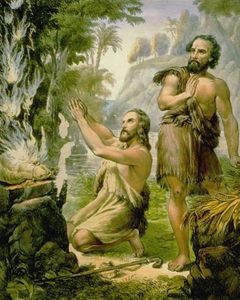
Claudius in Act 3 Scene 3 feels guilty for the sin he committed of (having sex with his brother’s wife then) killing the King, his brother. Claudius says, “O, my offense is rank, it smells to heaven; It hath the primal eldest curse upon ‘t, A brother’s murder.” The very first murder in the world was committed by Cain in killing his brother Abel. Cain was cursed with in Genesis Chapter 4 verses 11-12, “And now cursed art thou from the ground, which hath opened her mouth to receive thy brother's blood from thy hand. When thou tillest the ground, it shall not henceforth yield unto thee her strength; a fugitive and a wanderer shalt thou be in the earth.” The curse of Claudius is the fact that he killed his brother Hamlet and compares it to the biblical story of Cain and Abel.
In Act 3 Scene 2 Hamlet speaks of the Roman king, Nero, who historically is rumored to have killed his mother. “O heart, lose not thy nature; let not ever The soul of Nero enter this firm bosom.” Nero slept with his mother Agrippina, and then murdered her out of guilt. So too, here Hamlet’s aggression is targeted towards his mother as opposed to his guilty father as pointed out by http://elsinore.ucsc.edu/Freud/freudOrestes.html.
If you are interested in more allusions, this website does a great job of pointing out almost all of the ones used in Hamlet: http://www.whs.babienko.net/CollegePrep/Assignments/Hamlet/Allusions.pdf.

Symbolism is used in a great amount of literature. It’s goal is to add another layer of meaning to the text, and make it more intriguing. It allows the author to describe certain ideas without specifically stating them. Lord of the Flies is a great example of a book that uses symbolism. For example, the conch stood for democracy. Here, in Hamlet there are also many symbols. Throughout this section, the various symbols will be explained.
Ophelia’s Flowers
In Act 4 Scene 5 as Ophelia’s life is coming to an end there is a famous scene in which Ophelia hands out various flowers. Many commentators on Shakespearean literature claim these flowers represent many different feelings. Ophelia distributes flowers to three characters: Laertes, Claudius, and Gertrude. There is much argument as to who received each flower, because Shakespeare didn’t include it in his stage direction. According to the text, we felt like the following was the correct interpretation.
To Laertes, Ophelia gave rosemary which represents remembrance to tell her brother that he should always remember their dead father, Polonius and herself. She also gave him pansies which represent thoughts, because Laertes thought Hamlet and Ophelia couldn’t be together. Finally, she also gave him crowflowers which are beautiful, but poisonous and represent ingratitude. She is trying to symbolize the fact that she is beautiful, but her love for Hamlet poisons her. She also is ungrateful for her life, and kills her self.
To Claudius, Ophelia gives nettles and long purples. Nettles represent bad luck as if to say that she was unlucky in the fact that her father (Polonius) was inadvertently murdered, and the love of her life (Hamlet) was sent away to England. Ophelia’s death scene also symbolizes this notion of bad luck. She climbed out too far on the branch of a willow tree, fell into the brook, and later drowned. The willow represents sulking and sorrow. There is sadness for Ophelia, because her love was discharged, and her father deceased. A second layer to this weeping indicates Laertes’ feelings of despondency because his father died, and his sister, Ophelia died. Long purples are also called by their alternative name of dead men’s fingers. This is to say that the entire tragic play began as a result of the death of King Hamlet. This caused the younger Hamlet to kill Polonius, fight with Claudius, be mad at his mother, etc.
To Gertrude, Ophelia gave fennel, columbine, rue, and daisies. Fennel represents frailty, and Ophelia was pointing out the fact that Gertrude was frail. Columbine represents ingratitude, because Gertrude was ungrateful to King Hamlet by sleeping with his brother and later marrying him, and she was also ungrateful to her son, Hamlet by doing this. Rue, historically was used by women as a medicine to cause miscarriage. It was given to Gertrude to represent the fact that she is past her young, child-bearing years. Daisies represent innocence. Ophelia, although according to many critics died pregnant, is trying to show her innocence and the fact that she died a virgin.
Ghost
The ghost in the play has noteworthy symbolic significance. Coming back to haunt Hamlet, it represents the weight of the past on every character in the play. When the ghost confronts Hamlet, it drives him to insanity, which in turn leads him to seek revenge on his uncle. Hamlet’s plot to avenge his dead father cause a great deal of trouble for Claudius and Gertrude, representing the trouble caused them by their guilt and past crimes. The ghost could also represent madness and disorder, returning later in the play to set Hamlet back on his mission to kill his uncle and cause general havoc in the kingdom.
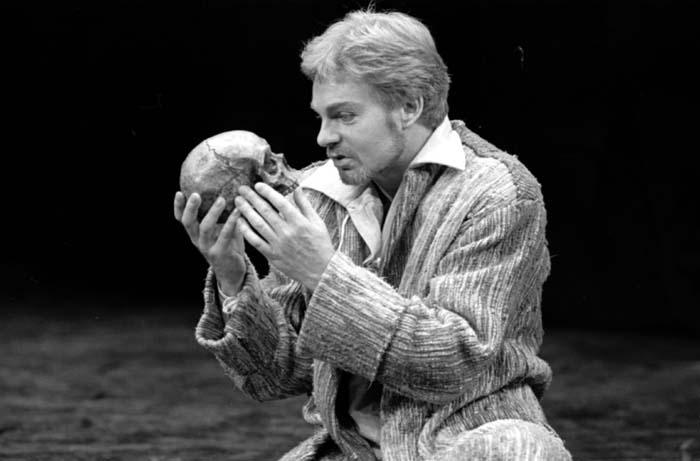
One of the most memorable and symbolically significant scenes in Hamlet is the scene with the Gravediggers/Clowns. Although this scene serves in large part as mere comic relief, it also contains a symbol that stands for one of the strongest themes in the play: death. Hamlet reflects on the finding of the skull, recalling how Yorick had once been a man whom Hamlet had loved and known well and mulling over the fact that Yorick had been reduced to a cold, sad skull. This symbol, one of the strongest and most jarring in the play, amplifies the message from the “To Be or Not to Be” soliloquy- that a person’s actions during his life have no meaning after he dies, and that ultimately death is supreme. Hamlet regards the skull with sad thoughtfulness, beyond the point of being depressed by the thought of death, and even finds bizarre humor in his friend’s death. This shows that Hamlet, whether through madness or through personal growth, has become all too familiar with death and possibly even come to accept it. This is a clear demonstration of one of Hamlet’s major themes- that all men, no matter how great, die.
